

Chailey Heritage Old Scholars Association
Website design by Ian Sowerby (ian@iansowerby.com) Hosting by My Tech Team
This piece is dedicated to all old scholars who served their country in
whatever capacity.
The Green Book ("Heritage Chailey 1903-1948") states that in St Martin's
chapel there is a memorial tablet dedicated to "28 Heritage boys who
were sufficiently cured to fight and give their lives for King and Country in
the First World War". This has always intrigued me. I couldn't imagine anyone who went to Chailey
being sufficiently cured to march off to war (with sticks and crutches). So were they some kind of
super-cripples or were they not so disabled in the first place? In any event, marching up and down
the Common would have put them a step ahead of the rest.
The memorial tablet or hatchment was erected in 1925, the same year the war memorial was
erected, and the same year the Red Book ("The Coming of Age of the Heritage Craft Schools") was
published. The tablet consists of the arms of King George V followed by the text
In commemoration of the
28 HERITAGE BOYS
who served in the
GREAT WAR
1914-1918
The Oxford Dictionary defines a hatchment as "a large tablet, typically diamond-shaped, bearing the
coat of arms of someone who has died, displayed in their honour". Strictly speaking the tablet,
although taking the form of a hatchment, does not follow this definition. The arms are those of King
George V but the commemoration is of the "boys". By calling it a hatchment however implies it is a
memorial to those who have died. Note that this is not confirmed by the text.
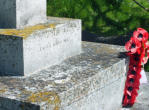
The elegant war memorial at the entrance to the Heritage bears the text
DULCE ET DECORUM
EST PRO PATRIA
MORT
IN MEMORY OF
28
HERITAGE BOYS
WHO SERVED IN
THE GREAT WAR
1914-1918
Leaving aside the Latin for the moment, the wording is the same as that on the memorial tablet apart
from minor variations. Unlike many First World War memorials however there is no list of names. The
boys are, perhaps surprisingly, anonymous.
The Latin is from the Roman poet Horace's Odes. If can be translated roughly as "It is sweet and right
to die for your country". It is also the title of a poem by the anti-war poet Wilfred Owen. The poem,
describing the sordid reality of war, ends
The old Lie; Dulce et Decorum est
Pro patria mori.
At the base of the war memorial is the school motto "Laetus Sorte Mea" which is translated as "happy
in my lot" or "happy with my lot". It seems to add a note of sadness to a memorial to boys who were
"sufficiently cured" only to lose everything.
The Green Book mentions that the war memorial is "to the twenty-eight Heritage boys who fought
and fell in the First World War". But, if these boys did give their lives for King and Country, why does it
not say so on the memorial? And, if they did, what of those who served but didn't give their lives?
They would also have "served in the Great War" but, not having died it it, literally did not count.
The Red Book, published just seven years after the war ended, is surprisingly vague about the boys.
There are just cursory mentions. "Guild boys have been cured sufficiently to enlist, and have laid
down their lives" and, in a reprinted Times article, "Chailey actually gave fighting men to England".
The meaning of "gave" in this contact is somewhat ambiguous. It could mean gave to serve or it
could mean gave their lives.
So, in the in the same year the memorial tablet and war memorial were dedicated with much pomp
and ceremony to the boys, why is there so little mention made of them in the Red Book? Would it not
have been to the credit of the Heritage, let alone the boys, to acknowledge their sacrifice? Perhaps it
served the times not to be too precise about who they were and how they served.
Ian Sowerby
The Twenty Eight